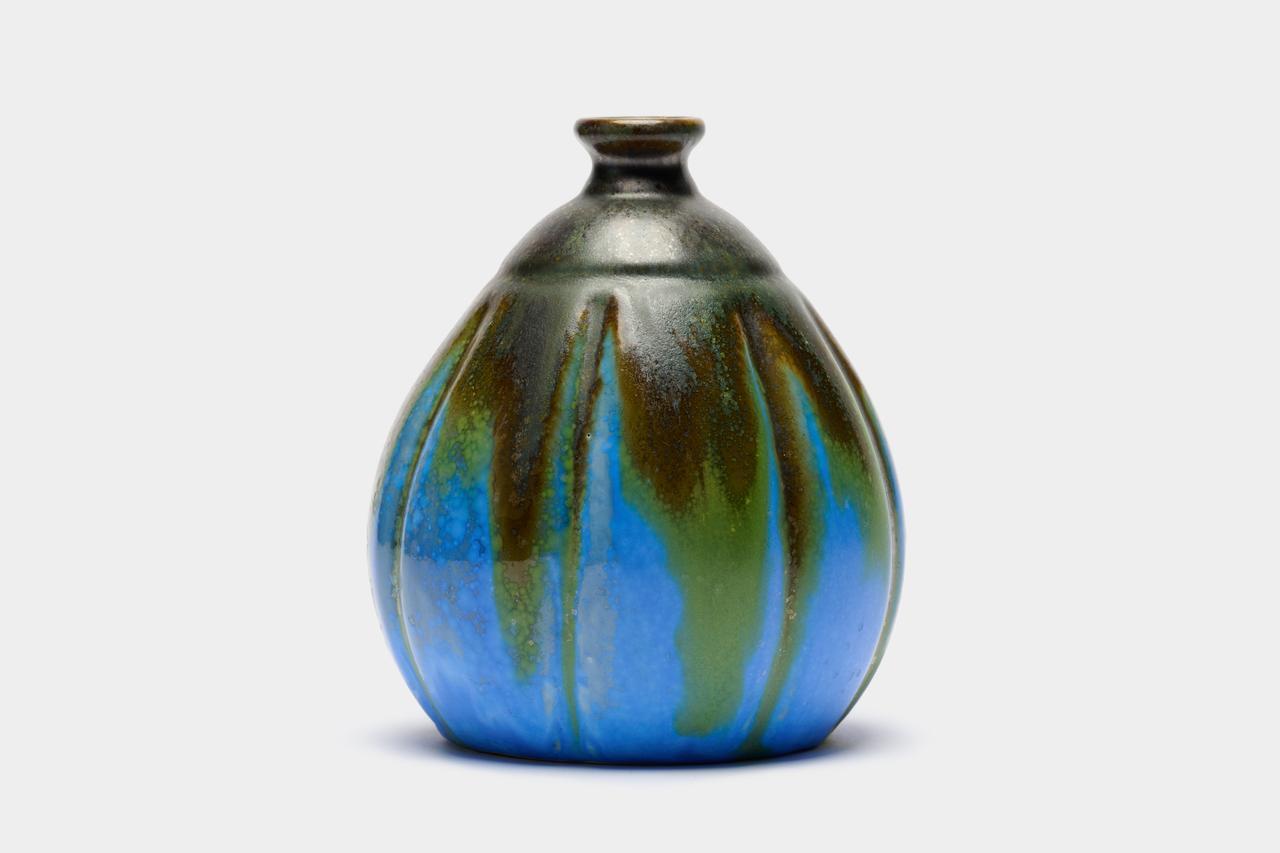
claudio pulli - claudio pulli - Lidded vase - ceramics - Ceramic

06
days
09
hours
21
minutes
01
second
Starting bid
€ 1
No reserve price
Sophie Aziz
Expert
Selected by Sophie Aziz

Held roles at Sotheby’s Paris with five years’ expertise in ceramics and glass.

Estimate  € 170 - € 200
No bids placed

Catawiki Buyer Protection

Your payment’s safe with us until you receive your object.View details

Trustpilot 4.4 | 130814 reviews

Rated Excellent on Trustpilot.

Claudio Pulli ceramic vase in multicoloured glazed ware with metallic lustres, 16 cm high, 16 cm wide and 16 cm deep, weighing 300 g, produced in Sardinia, Italy, dating from 1960–1970, in like new condition.

AI-assisted summary

Description from the seller

Claudio Pulli’s vase in polychrome glazed ceramic with metallic luster

Height: 16 cm


Claudio Pulli came to know Art in a family environment, being the son of the sculptor and decorator Giovanni (Lecce, 1892 – Selargius, Cagliari, 1976). His father trained in Lecce, the family's city of origin, in the workshop of the sculptor Luigi Guacci. Following a commission, Giovanni arrived in Sassari in 1929 and moved there with his family: at the time he had three children. In 1929 Giovanni Pulli opened his art workshop in the city, on Corso Vittorio Emanuele at number 89, and for nine years he had the assignment of teaching ceramics at the Sassari Art Institute. Claudio studied at the Sassari Art Institute and had teachers such as Maestros Stanis Dessy, Filippo Figari, and Eugenio Tavolara. The talents of the young Claudio, already well honed by the “family” apprenticeship he could undertake in his father’s workshop, were directed by the teachings of his masters at the Institute of Art (he was skilled in sculpture and painting). Pulli was noticed by Tavolara, who invited him to further perfect himself with an eye to the Italian scene. Thus, after earning the diploma of Master of Art in Sassari, Claudio Pulli went to Faenza, a major center of Italian ceramics, and refined his craft: his great love was terracotta, being truly predisposed to shaping and decorating it. In 1955 he married Graziella Doro, the love of a lifetime who saw the birth of Giovanni (1956) and Roberto (1961), who accompanied Claudio in his works and still today pass on the secrets of this ancient art.

From Faenza’s masters, Pulli learned various ceramic techniques (such as lead glazing, tin enamel, glassing, engobe) and conducted many experiments, curious and eager to obtain new material effects to artistically enhance. Shy and introspective in character, Pulli was a practical, direct, yet secluded man and artist: he deeply loved his work, the culture of making was his own. In his artistic career he participated in many exhibitions, winning important prizes and receiving numerous recognitions, in Italy and abroad. Among the notable shows is to be remembered “Sassari in Bottiglia,” born from an idea of the Sassari decorator Settimio Sassu (Sassari, 1918 – second half of the 20th century) and composed of glass bottles of various shapes on which caricatures of important figures from the world of culture, entertainment, and politics of postwar Sassari were formed: the body of the character was the glass container while the heads were molded by Sassu, by Pulli, and by the then very young Gian Carlo Marchisio, who collaborated.

Important exhibitions for Pulli were the 1970 edition of the Sardinia Trade Fair held in Cagliari and a solo show he organized years later in Tokyo. He also had a solo show at Faenza at the Civic Museum of Ceramics. From the early 1970s he opened his ceramic workshop in Selargius, near Cagliari, where he produced for decades his series and his unique pieces, inspired by Sardinia and its ancient crafts but also creating refined contemporary design objects. Sensitive as a man, introspective and fond of quiet, he also produced works of sacred art: in several churches in the province of Cagliari one can admire his Stations of the Cross, or his paintings or his statues.

Claudio Pulli’s vase in polychrome glazed ceramic with metallic luster

Height: 16 cm


Claudio Pulli came to know Art in a family environment, being the son of the sculptor and decorator Giovanni (Lecce, 1892 – Selargius, Cagliari, 1976). His father trained in Lecce, the family's city of origin, in the workshop of the sculptor Luigi Guacci. Following a commission, Giovanni arrived in Sassari in 1929 and moved there with his family: at the time he had three children. In 1929 Giovanni Pulli opened his art workshop in the city, on Corso Vittorio Emanuele at number 89, and for nine years he had the assignment of teaching ceramics at the Sassari Art Institute. Claudio studied at the Sassari Art Institute and had teachers such as Maestros Stanis Dessy, Filippo Figari, and Eugenio Tavolara. The talents of the young Claudio, already well honed by the “family” apprenticeship he could undertake in his father’s workshop, were directed by the teachings of his masters at the Institute of Art (he was skilled in sculpture and painting). Pulli was noticed by Tavolara, who invited him to further perfect himself with an eye to the Italian scene. Thus, after earning the diploma of Master of Art in Sassari, Claudio Pulli went to Faenza, a major center of Italian ceramics, and refined his craft: his great love was terracotta, being truly predisposed to shaping and decorating it. In 1955 he married Graziella Doro, the love of a lifetime who saw the birth of Giovanni (1956) and Roberto (1961), who accompanied Claudio in his works and still today pass on the secrets of this ancient art.

From Faenza’s masters, Pulli learned various ceramic techniques (such as lead glazing, tin enamel, glassing, engobe) and conducted many experiments, curious and eager to obtain new material effects to artistically enhance. Shy and introspective in character, Pulli was a practical, direct, yet secluded man and artist: he deeply loved his work, the culture of making was his own. In his artistic career he participated in many exhibitions, winning important prizes and receiving numerous recognitions, in Italy and abroad. Among the notable shows is to be remembered “Sassari in Bottiglia,” born from an idea of the Sassari decorator Settimio Sassu (Sassari, 1918 – second half of the 20th century) and composed of glass bottles of various shapes on which caricatures of important figures from the world of culture, entertainment, and politics of postwar Sassari were formed: the body of the character was the glass container while the heads were molded by Sassu, by Pulli, and by the then very young Gian Carlo Marchisio, who collaborated.

Important exhibitions for Pulli were the 1970 edition of the Sardinia Trade Fair held in Cagliari and a solo show he organized years later in Tokyo. He also had a solo show at Faenza at the Civic Museum of Ceramics. From the early 1970s he opened his ceramic workshop in Selargius, near Cagliari, where he produced for decades his series and his unique pieces, inspired by Sardinia and its ancient crafts but also creating refined contemporary design objects. Sensitive as a man, introspective and fond of quiet, he also produced works of sacred art: in several churches in the province of Cagliari one can admire his Stations of the Cross, or his paintings or his statues.

Details

Era
1900-2000
Weight
300 g
Specific region of origin
sardegna
Number of objects
1
Country of origin
Italy
Model
ceramics
Designer/artist/maker
claudio pulli
Material
Ceramic
Manufacturer/brand
claudio pulli
Condition
As new - unused
Height
16 cm
Width
16 cm
Depth
16 cm
Estimated period
1960-1970
ItalyVerified
143
Objects sold
100%
Private

Similar objects

For you in

Ceramics & Glass