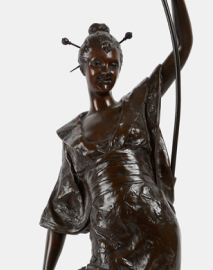
Sculpture, "POSEIDON" Dieu de la Mer - 19.5 cm - Composite

07
days
14
hours
22
minutes
29
seconds
Starting bid
€ 1
No reserve price
Paul Wullems
Expert
Selected by Paul Wullems

He accumulated 18 years' experience, worked as junior specialist at Sotheby’s and managed Kunsthandel Jacques Fijnaut.

Estimate  € 100 - € 150
No bids placed

Catawiki Buyer Protection

Your payment’s safe with us until you receive your object.View details

Trustpilot 4.4 | 134111 reviews

Rated Excellent on Trustpilot.

Description from the seller

Superb sculpture of the portrait of "POSEIDON" God of the Sea
It is in good condition no breakage
Ideal for Mediterranean decor for Loft , Gite , Office , Gite , Hotel , Restaurant , Showroom
------- Poseidon is a major Greek god, where he mainly acts as the god of the sea, of earthquakes and of horses, more generally an incarnation of the brute force of nature, also possessing other powers and attributes derived from the previous ones, for example those related to springs and fertility.
In myths, he is a Cronide, one of the sons of Cronos and Rhea, brother of Zeus, who receives sovereignty over the seas in the division of the world, while being subject to the supreme authority of the king of the gods. Several stories recount his failures to become the protector of cities, notably Athens. He regularly intervenes in other myths, rarely as a main character, but he can play an important role in the plot, in particular by carrying out vengeance for a fault committed against him or another god. He is credited with many conquests in addition to his wife Amphitrite, and a significant offspring, composed of characters often violent and menacing, but also founders of important human lineages.
The cults of Poseidon are widespread throughout the Greek world, where he is especially invoked to protect against perils during sea voyages, earthquakes and tidal waves, because he has the power to calm the forces of nature. He is also invoked as the god of horses, to allow control of their strength during races. His sanctuaries are rarely located in urban spaces but rather on the margins of inhabited spaces, notably on rocky promontories overlooking the sea, on islands, or near springs. Several serve as places of refuge and meeting places for leagues of cities.
The Romans assimilate him to their Neptune, who essentially preserves the marine traits of the Greek god. This explains why Poseidon is, above all, considered in modern representations as the god of the sea of the Greeks, leaving aside his other talents.

Superb sculpture of the portrait of "POSEIDON" God of the Sea
It is in good condition no breakage
Ideal for Mediterranean decor for Loft , Gite , Office , Gite , Hotel , Restaurant , Showroom
------- Poseidon is a major Greek god, where he mainly acts as the god of the sea, of earthquakes and of horses, more generally an incarnation of the brute force of nature, also possessing other powers and attributes derived from the previous ones, for example those related to springs and fertility.
In myths, he is a Cronide, one of the sons of Cronos and Rhea, brother of Zeus, who receives sovereignty over the seas in the division of the world, while being subject to the supreme authority of the king of the gods. Several stories recount his failures to become the protector of cities, notably Athens. He regularly intervenes in other myths, rarely as a main character, but he can play an important role in the plot, in particular by carrying out vengeance for a fault committed against him or another god. He is credited with many conquests in addition to his wife Amphitrite, and a significant offspring, composed of characters often violent and menacing, but also founders of important human lineages.
The cults of Poseidon are widespread throughout the Greek world, where he is especially invoked to protect against perils during sea voyages, earthquakes and tidal waves, because he has the power to calm the forces of nature. He is also invoked as the god of horses, to allow control of their strength during races. His sanctuaries are rarely located in urban spaces but rather on the margins of inhabited spaces, notably on rocky promontories overlooking the sea, on islands, or near springs. Several serve as places of refuge and meeting places for leagues of cities.
The Romans assimilate him to their Neptune, who essentially preserves the marine traits of the Greek god. This explains why Poseidon is, above all, considered in modern representations as the god of the sea of the Greeks, leaving aside his other talents.

Details

Era
1900-2000
Country of origin
Greece
Material
Composite
Title of artwork
"POSEIDON" Dieu de la Mer
Signature
Not signed
Condition
Good condition
Height
19.5 cm
Width
13 cm
Depth
8 cm
Weight
989 g
FranceVerified
1309
Objects sold
98.15%
Privatetop

Similar objects

For you in

Sculptures & Figurines