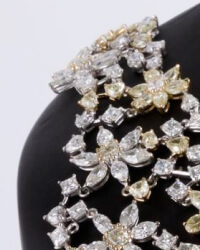
Brooch - 18 kt. Yellow gold Diamond (Natural) - Ruby


She has 15 years' auction experience, specialising in vintage jewellery from 1920 to 2000.
Catawiki Buyer Protection
Your payment’s safe with us until you receive your object.View details
Trustpilot 4.4 | 141255 reviews
Rated Excellent on Trustpilot.
Antique two-tone gold brooch in yellow and grey gold, set with three natural rose-cut diamonds and three synthetic old-cut rubies, circa 1895–1910 in an Art Nouveau naturalist design, with a missing ruby and an original hinge and pin clasp reinforced for lace or ribbon wear, accompanied by no laboratory report.
Description from the seller
Ancient naturalist brooch in two-tone gold set with rose-cut diamonds and synthetic rubies from the period – Belle Époque, circa 1895-1910.
Openwork brooch with a vegetal motif composed of scrolls and finely engraved foliage. The setting is made of yellow gold with elements in gray/white gold designed to enhance the sparkle of the diamonds, a technique used in jewelry making at the end of the 19th century.
It is adorned with natural rose-cut diamonds, pavé-set, as well as calibrated synthetic old rubies (corundum obtained by the Verneuil process, used in jewelry from the early 20th century).
Note: one ruby is missing.
Original fastening system preserved with a pin clasp and hook, accompanied by its articulated back reinforcement allowing better wear on fine fabric (lace, silk or ribbon), typical of Belle Époque corsage brooches.
Several punches/hallmarks (eagle head and silversmith/goldsmith) visible on the setting.
Condition: traces of use and minor old knocks visible, some leaves broken, mechanical operation very good.
Period: around 1895-1910
Style: Belle Époque / naturalist
Material: two-tone gold
Stones: natural rose-cut diamonds, synthetic old rubies
Technique: pavé setting, openwork mounting
Antique jewelry authentic, not altered.
Ancient naturalist brooch in two-tone gold set with rose-cut diamonds and synthetic rubies from the period – Belle Époque, circa 1895-1910.
Openwork brooch with a vegetal motif composed of scrolls and finely engraved foliage. The setting is made of yellow gold with elements in gray/white gold designed to enhance the sparkle of the diamonds, a technique used in jewelry making at the end of the 19th century.
It is adorned with natural rose-cut diamonds, pavé-set, as well as calibrated synthetic old rubies (corundum obtained by the Verneuil process, used in jewelry from the early 20th century).
Note: one ruby is missing.
Original fastening system preserved with a pin clasp and hook, accompanied by its articulated back reinforcement allowing better wear on fine fabric (lace, silk or ribbon), typical of Belle Époque corsage brooches.
Several punches/hallmarks (eagle head and silversmith/goldsmith) visible on the setting.
Condition: traces of use and minor old knocks visible, some leaves broken, mechanical operation very good.
Period: around 1895-1910
Style: Belle Époque / naturalist
Material: two-tone gold
Stones: natural rose-cut diamonds, synthetic old rubies
Technique: pavé setting, openwork mounting
Antique jewelry authentic, not altered.
Details
Disclaimer
Catawiki always aims to offer you the best possible buying experience. Our experts virtually review and select every object in line with our submission guidelines. While we strive to provide a detailed description and photographs of each jewellery object, discrepancies or inaccuracies may occur. It is your responsibility to review all of the information provided about an object, including the condition and description, before placing an order. Sellers are responsible for the information, pictures and description provided, including the quality, quantity and nature of the jewelry supplied. A small imperfection that cannot be seen in the photo but is included in the description is not a non-conformity. A Lab Report is not a guarantee, valuation or appraisal regarding the articles described therein. A Lab Report contains only the characteristics of an article described after it has been graded, tested, examined, and analyzed using the techniques and equipment used at the time of the examination from that specific Lab. The results of any other examination performed on the article may differ depending when, how, by whom and with which grading standard the article is examined. In addition, any changes and improvements in techniques and equipment that may have occurred which may enable the examiner to detect, among other things, the use of processes for altering the characteristics of an article which use was previously undetectable, does not automatically mean the object does not conform to its description.