Nr. 100195460

Niet meer beschikbaar
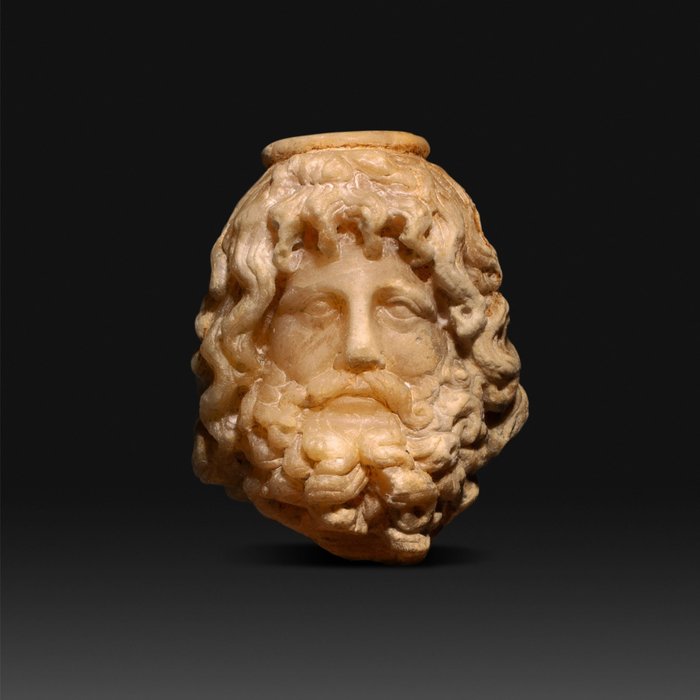
Oud-Romeins Albast Serapis-hoofd. 1e - 2e eeuw na Christus. 9,5 cm hoog. Spaanse exportlicentie.
Bieden gesloten
2 dagen geleden

Oud-Romeins Albast Serapis-hoofd. 1e - 2e eeuw na Christus. 9,5 cm hoog. Spaanse exportlicentie.

Serapis Head. Ancient Roman, 1st - 2nd century AD. Alabaster. Height 9.5 cm and 20 cm with the stand. PROVENANCE: Private collection, France. Acquired by family inheritance. 1970. CONDITION: In a good state of preservation. DESCRIPTION: A beautiful head that belonged to a bust or sculpture, sculpted in translucent alabaster, of the syncretic Egyptian-Roman deity Serapis. It was probably intended to be placed on a private altar or as decoration in a room of a Roman domus. Similar examples have been found in both Egypt and Rome, as well as in other cities on the Italian peninsula. Its sculptural style suggests that it may well have been made in Egypt. This deity is depicted in its most common form: an adult male with long hair and beard. The essential attribute that distinguished the images of Serapis from those of other similar gods is the calathus or modius, the sacred basket of the mysteries, symbol of abundance, which would have been made piece by piece. It unites the concepts of agricultural fertility, life and death; it was used in the art of Ancient Egypt and in the Greco-Roman world. It resembles the bun that was worn on the head to carry something heavy. Its name was given by scholars because of its resemblance to the Roman modius, an utensil used as a unit of measurement for grain capacity. Ptolemy I, the first Greek ruler of Egypt after the death of Alexander the Great, declared Serapis to be the patron saint of Alexandria and the official god of Egypt and Greece, thus linking the two peoples. Ptolemy's intention was probably to find a deity who would command the respect and veneration of the Hellenes and the intensely traditionalist Egyptians alike. It is unlikely that the Greeks would have accepted a zoocephalous deity, in the Egyptian manner, whereas the Egyptians would have been more willing to accept any aspect for this god. A typical Greek icon was therefore chosen, which was proclaimed to be the anthropomorphic equivalent of a much revered Egyptian divinity, the ox Apis, assimilated to Osiris. Serapis is thus a syncretic divinity in which cultic practices of different origins are synthesised in a new image. Notes: The piece includes authenticity certificate. The piece includes Spanish Export License (Passport for European Union) - If the piece is destined outside the European Union a substitution of the export permit should be requested. This process could take between 1 and 2 months. #MasterpiecesW39

Nr. 100195460

Niet meer beschikbaar
Oud-Romeins Albast Serapis-hoofd. 1e - 2e eeuw na Christus. 9,5 cm hoog. Spaanse exportlicentie.

Oud-Romeins Albast Serapis-hoofd. 1e - 2e eeuw na Christus. 9,5 cm hoog. Spaanse exportlicentie.

Serapis Head.

Ancient Roman, 1st - 2nd century AD.

Alabaster.

Height 9.5 cm and 20 cm with the stand.

PROVENANCE: Private collection, France. Acquired by family inheritance. 1970.

CONDITION: In a good state of preservation.

DESCRIPTION:

A beautiful head that belonged to a bust or sculpture, sculpted in translucent alabaster, of the syncretic Egyptian-Roman deity Serapis. It was probably intended to be placed on a private altar or as decoration in a room of a Roman domus. Similar examples have been found in both Egypt and Rome, as well as in other cities on the Italian peninsula. Its sculptural style suggests that it may well have been made in Egypt.

This deity is depicted in its most common form: an adult male with long hair and beard. The essential attribute that distinguished the images of Serapis from those of other similar gods is the calathus or modius, the sacred basket of the mysteries, symbol of abundance, which would have been made piece by piece. It unites the concepts of agricultural fertility, life and death; it was used in the art of Ancient Egypt and in the Greco-Roman world. It resembles the bun that was worn on the head to carry something heavy. Its name was given by scholars because of its resemblance to the Roman modius, an utensil used as a unit of measurement for grain capacity.

Ptolemy I, the first Greek ruler of Egypt after the death of Alexander the Great, declared Serapis to be the patron saint of Alexandria and the official god of Egypt and Greece, thus linking the two peoples. Ptolemy's intention was probably to find a deity who would command the respect and veneration of the Hellenes and the intensely traditionalist Egyptians alike. It is unlikely that the Greeks would have accepted a zoocephalous deity, in the Egyptian manner, whereas the Egyptians would have been more willing to accept any aspect for this god. A typical Greek icon was therefore chosen, which was proclaimed to be the anthropomorphic equivalent of a much revered Egyptian divinity, the ox Apis, assimilated to Osiris. Serapis is thus a syncretic divinity in which cultic practices of different origins are synthesised in a new image.


Notes:

The piece includes authenticity certificate.
The piece includes Spanish Export License (Passport for European Union) - If the piece is destined outside the European Union a substitution of the export permit should be requested. This process could take between 1 and 2 months.
#MasterpiecesW39


Bieden gesloten
Ruth Garrido Vila
Expert
Geschatte waarde  € 12.000 - € 15.000

Vergelijkbare objecten

Voor jou in

Archeologie

Stel een zoekopdracht in
Stel een zoekopdracht in om een melding te ontvangen wanneer er nieuwe resultaten zijn.

Dit object was te vinden in


Zo koop je op Catawiki

Meer informatie over onze Kopersbescherming

      1. Ontdek iets bijzonders

      Verken duizenden bijzondere objecten die door experts zijn geselecteerd. Bekijk de foto's, de details en de geschatte waarde van elk bijzonder object. 

      2. Plaats het hoogste bod

      Vind iets waar je van houdt en plaats het hoogste bod. Je kunt de veiling volgen tot het einde of je kunt ons systeem voor je laten bieden. Het enige dat je hoeft te doen, is het maximale bedrag instellen dat je wilt betalen. 

      3. Veilig betalen

      Betaal voor je bijzondere object en we houden de betaling veilig totdat je nieuwe aanwinst veilig is bezorgd. We gebruiken een vertrouwd betalingssysteem om alle transacties af te handelen. 

Wil je iets vergelijkbaars verkopen?

Of je nu nieuw bent met online veilingen of professioneel verkoopt, wij kunnen je helpen meer te verdienen met je bijzondere objecten.

Verkoop je object
